
AS Aabhishek Siloya
Customer Strategy · The Relationship Issue
London at dusk over the river
Customer Strategy

Know.
Own.
Grow.

The new grammar of the customer relationship, and why every premium brand must learn it in that order.

Written by Aabhishek Siloya
Direction with Rebecca Burdess
Edition The Relationship Issue

With sincere thanks to Rebecca Burdess, whose direction, thought process and generosity of perspective during my time at Maybourne helped shape the framework behind this essay.

A strategy editorial for premium hospitality, private membership and luxury service businesses that need customer intimacy to become an operating advantage.

Excellence of product may win attention. Excellence of relationship is what compounds.

Opening Argument

There is a particular kind of arrogance that has long afflicted the luxury industry: the belief that excellence of product is, by itself, sufficient.

A room of museum-worthy provenance, a dining room guided by a three-starred hand, a spa rooted in centuries of ritual. These things do speak. But the guest, however dazzled, does not return indefinitely because the product was once extraordinary.

The data disagrees with that old assumption. An engaged elite customer can be up to twenty-seven times more valuable than the average when retention, cross-sell and advocacy are allowed to compound together.

That is not a marginal improvement in commercial performance. It is a category difference: the distance between a business that survives and one that endures.

The question, then, is not whether to invest in the customer relationship. It is how to think about it with sufficient rigour that investment becomes architecture, and architecture becomes advantage.

The framework at a glance

At the heart of a new generation of customer strategy sits a deceptively simple proposition. Every interaction a premium brand has with a guest is in service of one of three intents.

The first intent is to Know: to see the customer clearly, to decode not merely who they are but what they value, what they fear losing, and what delights them at a register that is invisible to the untrained eye.

The second intent is to Own: to hold the relationship directly, not through an intermediary, not through an aggregator, but person to person, database to doorstep, in a manner that feels not merely efficient but genuinely earned.

The third intent is to Grow: to compound the value of what has been built. To turn one stay into a pattern. One pattern into a relationship. One relationship into a household. One household into a generation.

These three intents are not parallel. They are sequential. You cannot own what you do not know. You cannot grow what you do not own.
27x

The commercial case for remembering beautifully.

When retention, cross-sell and advocacy compound together, the engaged elite customer changes the economics of the entire relationship model.

One customer. Three intents.

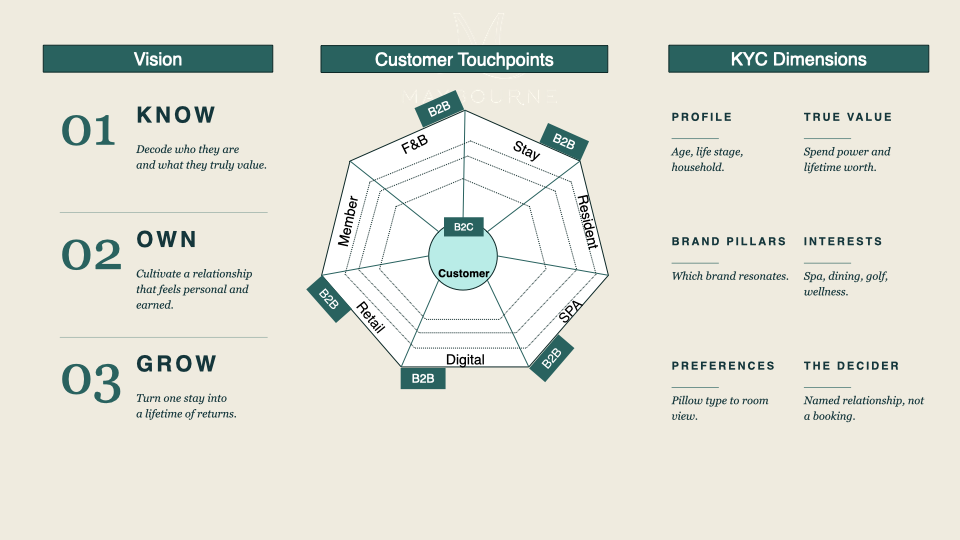
The framework maps five customer dimensions and seven owned touchpoints around a single customer record. It is simple enough to remember, but demanding enough to expose where the operating model breaks.

The real work is not collecting more data. The real work is making the organisation capable of recognising, acting and improving across every premium encounter.

Know Own Grow framework architecture diagram
Framework architecture: five dimensions, seven touchpoints and the customer at the centre.
I. Know

The architecture of understanding.

Knowledge is not passive accumulation. It is an active, governed and continuously refreshed discipline. The five dimensions below form the minimum portrait required to serve a premium customer with intelligence.

01

Demography

Age, geography, household, profession and life stage. The contextual floor for targeting, eligibility and service relevance.

02

True Value and Risk

Realised spend, predicted lifetime value, churn signal, risk and recovery investment. The hierarchy behind scarce attention.

03

Areas of Interest

Travel, wellness, art, family, philanthropy, sport and food. The signals that earn attention beyond the transaction.

04

Preferences

Room, dining, spa, channel, dietary, gifting and arrival cues. The operating detail of intimacy.

05

Brand Pillars

Craft, service, place, design and meaning. Not every guest comes for the same reason, and treating them as if they do is not luxury.

The Signal Chain

Every owned moment is evidence.

The data does not arrive by declaration alone. It arrives through disciplined, consented, first-party observation at the moments the brand controls.

Booking

Transaction data

Reservations, dining, spa, retail, events and accounts reveal what the customer has already chosen to pay for.

Voice

Customer truth

Surveys, reviews, complaints and recovery notes capture emotional temperature and service consequence.

On Site

Human signals

Check-in, concierge, dining choices and staff observations are rich, perishable and too often lost to the shift change.

Digital

Owned dialogue

Web, app, email, push, social sentiment and loyalty behaviour should become conversation, not broadcast.

“

Five dimensions. Seven touchpoints. One customer at the centre.

II. Own

The discipline of the direct relationship.

To own the customer relationship is not a possessive act. It is stewardship. It is the decision that the relationship will be held directly, with a clear owner, data flow, recovery path and standard of recognition.

01

The Stay

The hero moment, from pre-arrival recognition to follow-up that invites continuation.

02

Food and Beverage

The most frequent touchpoint and often the richest preference signal in the portfolio.

03

Spa

High-care, intimate and personal. Wellness information is a form of trust.

04

Retail

Taste, gifting and aspiration become visible in a way few other contexts allow.

05

Digital

The only touchpoint the brand controls entirely on its own terms.

06

Membership

The private office, curated programme and pre-emptive recognition at full maturity.

07

Residences

A slower, more domestic cadence with the same standard of memory.

The customer cannot tell where the operational boundary lies. Only whether they were remembered.

III. Grow

Growth is compounding, not campaigning.

Growth in the customer relationship operates more like investment than acquisition. It is patient, deliberate and oriented toward the long return.

01

Recognition

The guest never repeats themselves. Continuity becomes the baseline.

02

Personalisation

The right offer, moment, channel and tone, derived from the actual record.

03

Cross-sell

From share of occasion to share of life across stay, dining, wellness, retail and belonging.

04

Retention

Lifecycle, win-back and recovery run as deliberate disciplines, not exceptions.

05

Advocacy

Referrals and member-introduces-member networks become the least replicable growth channel.

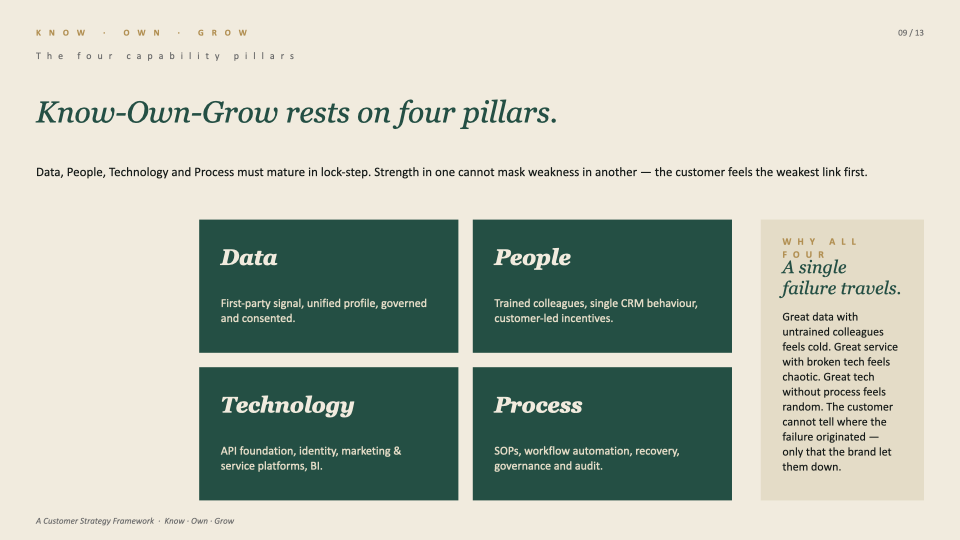
Four pillars of Know Own Grow: data, people, technology and process
Capability pillars: the weakest pillar sets the experience ceiling.

Where strategy meets reality.

The elegance of the framework rests on its simplicity. The difficulty rests on a more demanding truth: data, people, technology and process must mature together.

Great data with undertrained colleagues feels cold. Great service over broken technology feels chaotic. Great technology without governing process feels arbitrary.

Four Pillars

The operating system behind the feeling.

The relationship only becomes defensible when the underlying capabilities work in lock-step.

D

Data

First-party signal unified into one canonical guest record, governed, consented and refreshed.

P

People

Trained colleagues with the tools and incentives to capture the details that create continuity.

T

Technology

APIs, identity, service platforms and insight surfaced where service decisions are made.

P

Process

Published standards, workflow automation and recovery protocols triggered by design.

The Honest Reckoning

Where the model breaks today.

Data silos, stale records, skill gaps, disjointed identity and reporting tools that never reach the front line remain the structural failures of most premium customer strategies.

Data

Silos and quality

Duplicate records, missing consents and low profile completion rates compromise the very systems meant to personalise.

People

Skill gaps

Colleagues cannot create continuity if they lack training, time or reason to update the record.

Identity

Fragmented guests

One customer registered under multiple logins, membership numbers and emails becomes several strangers.

Insight

Archaeology

Reporting that lives in a weekly dashboard is not operational intelligence if service teams cannot use it.

The path forward.

The improvement strategy is built on twelve commitments: three for each pillar. They move the organisation from intention to operating standard.

First

Instrument

Choose the five dimensions and seven touchpoints. Measure the gaps rather than estimating them.

Then

Operationalise

Wire data, people, technology and process to a shared customer record that can be used in service.

Finally

Compound

Run lifecycle, advocacy and recovery as measured disciplines, not as reactions.

Maturity Ladder

Movement is the metric.

The score matters less than direction. A Level Two organisation moving toward Level Three with clarity is stronger than a Level Three organisation drifting.

L1

Initial

Heroic effort. Systemic absence. Outcomes depend on exceptional individuals rather than architecture.

L2

Emerging

Foundations are being assembled. The organisation can see where it needs to go.

L3

Mature

No major pain points remain. Outcomes are predictable and the capability becomes an asset.

L4

Leading

The capability becomes a differentiator that competitors and partners benchmark against.

Know. Own. Grow. In that order.

Knowing without owning is observation. Owning without growing is stagnation. Growing without knowing is luck.

The customer relationship, built this way, becomes the most defensible asset in the business. Not the product, which can be replicated. Not the location, which can be approached. The relationship: singular, earned and remembered.

A special thank you to Rebecca Burdess. This framework carries the imprint of her direction and exceptional thought process from my time at Maybourne.

Aabhishek Siloya